10 Best Paper Cup Manufacturers for Global Buyers?
Choosing the right Paper Cup manufacturer can influence product safety, brand image, delivery stability, and long-term costs. Global buyers often compare more than printed designs and factory prices. They examine material quality, production capacity, quality controls, customization options, and export experience. A reliable supplier should explain its paper grades, coating choices, cup sizes, packaging methods, and inspection procedures clearly. Small details matter. A weak rim seal may cause leaks during transport or customer use.
This guide introduces ten manufacturers frequently considered by international buyers. The selection focuses on practical purchasing factors, including food-contact documentation, factory capabilities, sampling support, minimum order quantities, and shipping coordination. It also considers how suppliers handle artwork approval, color consistency, production delays, and complaint resolution. These points reflect common sourcing experience rather than attractive marketing claims. No ranking is perfect. Buyer priorities differ across cafés, distributors, catering companies, and large retail chains. A low unit price may conceal higher freight costs or inconsistent quality. A famous supplier may still be unsuitable for a smaller order. Buyers should verify current certifications, production sites, test reports, and contract terms before placing orders. Ask for samples. Check the seal. Measure the cup. This guide is a starting point, not a substitute for due diligence. It aims to help global purchasers ask sharper questions and choose a manufacturer with dependable performance, transparent communication, and realistic delivery commitments.
Paper Cup Market Snapshot: 2024 Volume, Value, and Regional Growth Data
10 Best Paper Cup Manufacturers for Global Buyers?
Paper Cup Market Snapshot: 2024 Volume, Value, and Regional Growth Data
The 2024 paper cup market lacks one universal measurement. Grand View Research estimated global revenue at about USD 13 billion in 2023, with steady growth through 2030. Mordor Intelligence places the 2024 value near USD 12–13 billion. The gap reflects different definitions, regions, and coating categories. Buyers should compare methodology, not only headline numbers.
Industry estimates commonly place annual global consumption above 500 billion paper cups. That figure remains difficult to verify. Disposable foodservice data often combines paperboard cups with related packaging. Still, demand is clear in takeaway coffee, quick-service restaurants, offices, and delivery channels. Asia-Pacific holds the largest consumption base. Its growth is supported by urban populations, beverage outlets, and expanding organized foodservice. North America and Europe show slower volume growth, but higher demand for recyclable designs and fiber-based materials.
Regional growth is not uniform. Market reports generally project Asia-Pacific growth above the global average, while mature markets focus more on material performance and recovery systems. The data deserves caution. A cup may be recyclable in theory, yet local facilities may reject its lining. Global buyers should examine barrier materials, rim strength, leak resistance, food-contact compliance, and audited production capacity. These details often matter more than a low unit price.
Asia-Pacific represented the largest estimated share of the paper cup market in 2024, supported by high beverage consumption and expanding foodservice demand. Europe and North America remained major value markets, while Latin America and the Middle East & Africa recorded faster growth from a smaller base. Regional values and volumes are rounded estimates synthesized from publicly reported 2024 market research ranges; company and brand data are excluded.
2024 estimates: market value in USD billions, volume in billions of cups, and growth as estimated 2024–2029 CAGR.
Product Benchmarks: 180–350 GSM Board, 3–22 oz Sizes, and Barrier Types
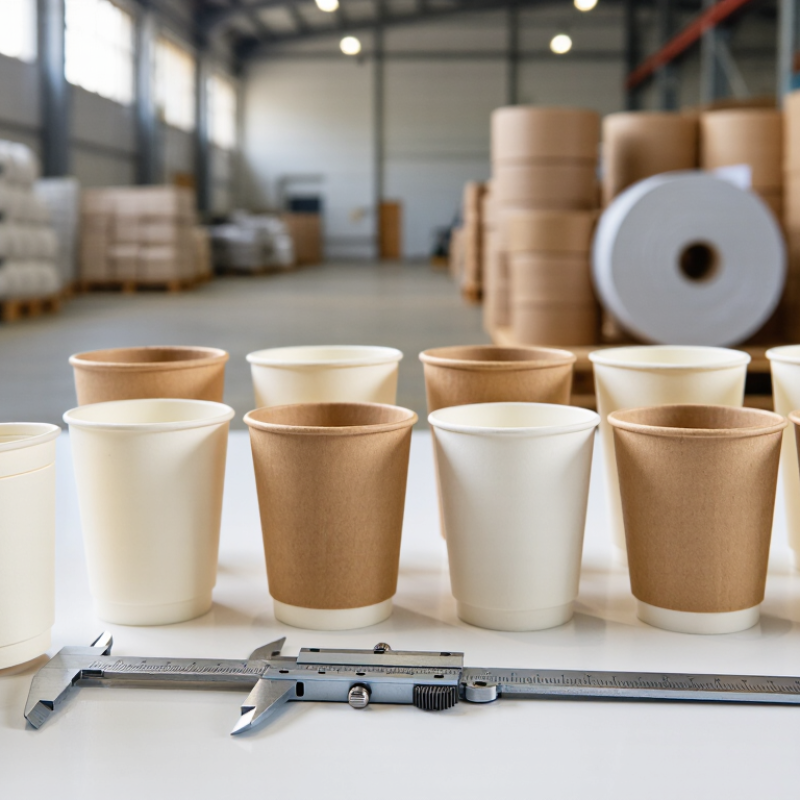
Global buyers comparing paper cup manufacturers should start with measurable product benchmarks, not attractive catalogs. For most hot and cold applications, board weight around 180–350 GSM offers a practical comparison range. Lower GSM can reduce material use, but it may feel soft or lose shape near heat. Heavier board improves stiffness, yet it can increase shipping weight and forming pressure. That trade-off matters. During supplier reviews, I check rim roundness, side-seam consistency, and cup compression by hand and machine. A neat sample can still hide weak production control.
Size selection should match the serving occasion, filling line, and transport method. Small 3–5 oz cups suit tastings, espresso servings, and controlled portions. Mid-range 7–12 oz sizes work well for coffee, juice, and routine takeaway service. Larger 16–22 oz cups need stronger walls and reliable sealing, especially with cold drinks and ice. Capacity labels deserve caution. Actual fill volume can differ from stated volume.
Barrier choice also affects performance, recyclability claims, and purchasing risk. Single- or double-sided polyethylene coatings provide familiar moisture resistance for many applications. Water-based dispersions may suit buyers seeking alternative coating systems, but suppliers should prove heat, grease, and leak resistance. I request coating-weight data, GSM tolerance, migration documentation, and hot-hold test results. Supplier claims are not evidence. One weakness in my own evaluations is overvaluing a polished sample. Repeated production samples, independent testing, and factory quality records usually reveal more. Teams should also inspect cartons, pallet stability, and storage conditions before approving a large order.
Supplier Scorecard: ISO 9001, BRCGS, MOQ, Capacity, and Export Reach
Choosing among the 10 best paper cup manufacturers requires more than comparing glossy catalogs. A practical supplier scorecard should verify ISO 9001 procedures, BRCGS food safety controls, minimum order quantity, production capacity, and export experience. Ask for current certificates, not scanned documents from several years ago. Check the certificate scope, expiry date, and registered manufacturing site.
MOQ can quietly change the project economics. A factory may accept 50,000 cups, but custom printing could require 100,000 units. Request a written quotation covering cup size, paper thickness, coating, artwork colors, packaging, and tooling fees. Capacity should be measured against real equipment and staffing. A claimed monthly output means little if peak-season orders already fill the schedule. Ask for recent production records or a confirmed lead-time plan.
Export reach also needs evidence. Review experience with customs documents, pallet standards, shipping terms, and destination-market labeling. A supplier serving multiple regions may understand port delays better, but broad reach does not guarantee consistent quality. I would sample cups after storage, stacking, and hot-liquid testing. Small leaks often appear only after several hours. The scorecard is useful, but not perfect; one overlooked coating detail can damage an otherwise strong evaluation. Leave room for rechecking assumptions.
10 Best Manufacturers: Materials, Output, Certifications, and Buyer Fit
Choosing among the 10 best paper cup manufacturers requires more than comparing unit prices. Reliable suppliers usually offer food-grade paperboard, commonly between 170 and 350 gsm, with polyethylene, PLA, or water-based barriers. Each coating suits a different use. Hot coffee needs strong heat resistance, while chilled drinks require dependable moisture protection.
Production capacity separates experienced factories from traders. Some manufacturers produce 20 million cups monthly, while smaller specialists focus on custom sizes and short runs. Ask for actual output records, not only website claims. Request samples, carton dimensions, leak-test results, and rim measurements. Small defects matter. A loose lid can damage an otherwise excellent order.
Certifications also reveal buyer fit. Look for ISO 9001 quality systems, FSC-certified paper options, and documented food-contact compliance for the destination market. Compostable products need credible test reports, not vague environmental language. A high-volume importer may need automated inspection, stable lead times, and palletized shipping. A café chain may value printed color accuracy and flexible minimum order quantities more. Check whether the factory controls printing, forming, packing, and testing in-house. Some do not.
Price is only one part. Freight, rejection rates, mold charges, and replacement policies can change the real cost. I would still keep one smaller supplier on the shortlist. Larger factories can overlook urgent custom requests. That trade-off deserves honest review.


